
SpaceX Investigates Starship Flight 15 Booster Catch Abort
SpaceX's Starship Flight 15 aimed to recover both stages but the booster aborted its catch attempt due to a low fuel alert, leading to investigations.
Introduction
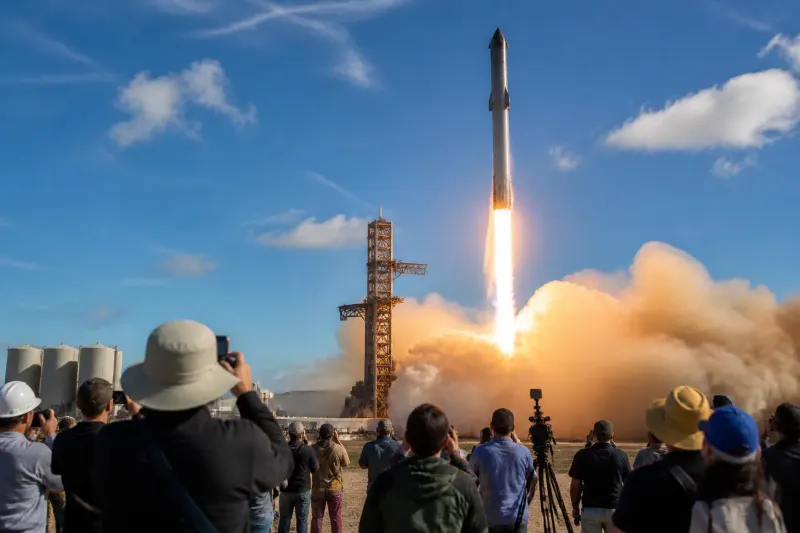
SpaceX's ambitious Flight 15 of its Starship rocket faced an unexpected disruption on November 13, 2026, when the booster failed to complete its planned landing for a mid-air catch by the launch tower's "chopstick" arms. Instead, the Super Heavy booster detonated during an emergency splashdown in the Gulf of Mexico. Though the launch was otherwise successful, with the upper stage reaching low Earth orbit (LEO), the circumstances surrounding the booster’s failure have prompted an investigation from the aerospace company.
Launch Details and Objectives
SpaceX launched the Flight 15 mission at 5:47 p.m. EST from its Starbase facility in Boca Chica, Texas. The mission aimed to test both the Super Heavy booster and the Ship upper stage, with hopes of executing the first complete recovery of an orbital launch system. This eventual reuse is central to SpaceX's strategy of enhancing the accessibility of space travel.
The Flight 15 mission aims included:
- Successfully landing both the Super Heavy booster and the Ship upper stage.
- Providing significant data to improve safety and reliability for future missions.
- Deploying 26 next-gen Starlink V3 satellites into orbit.
The Unplanned Abort
Despite initially favorable conditions, shortly after launch, the Super Heavy booster experienced an abort trigger shortly before it was scheduled to be caught mid-air. This was reported to be caused by a low-fuel alarm that prompted the booster to veer off course, leading to a controlled offshore splashdown. SpaceX’s Dan Huot explained that a Guidance and Navigation Control (GNC) issue was identified but clarified later that the GNC functioned correctly in detecting that it was not in the right position for a catch.
Recovery Attempt and Initiatives
With the Super Heavy diverting to a splashdown, the focus shifted to the upper stage, referred to as Ship 42. It successfully completed its mission objectives, reaching orbit and deploying its payload. The mission underscored the ongoing challenges of a dual catch attempt, particularly the complexity and risk involved in retrieving the upper stage after an orbital flight.
Previous Recovery Successes
This was not the first test for SpaceX’s booster recovery capabilities. SpaceX has successfully caught the Super Heavy booster on three prior occasions, but this was the first attempt to catch the Ship upper stage, which has proven to be more complicated due to its high altitude and velocity during reentry.
In summary, the previous successful catches include:
- Flight 11: Booster successfully recovered.
- Flight 9: Booster successfully recovered.
- Flight 7: Booster successfully recovered.
What Comes Next?
In the wake of the booster mishap, SpaceX continues to assess the performance data. Flight 15's upper stage is scheduled to make multiple orbits before returning to the launch site for a potential landing attempt. The company plans to evaluate the results of the heat shield inspections conducted by the Starlink V3 satellites equipped with cameras after deployment.
SpaceX will have several planned contingency checkpoints throughout the mission timeline, assessing the viability of the controlled returns. The first of these checkpoints comes shortly after the completion of satellite deployment, with further evaluations leading up to the planned entry and landing attempts. The final safety assessment is expected just before the ship’s return.

Future Outlook and Importance
The aim of full reusability is fundamental not only for SpaceX's strategies but for ongoing missions within NASA's Artemis program, which includes plans to use Starship as the lunar lander for astronauts. SpaceX’s efforts to enhance rapid reusability are crucial for the anticipated high launch cadence, aiming for around 10,000 launches per year by 2030.
Elon Musk has emphasized the significance of recovery and reusability, stating that the dual-catch effort would bolster the long-term prospects of making space exploration more routine and accessible.
Flight Overview and Objectives
| Test Flight | Booster Recovery Success | Launch Date | Payload Deployed |
|---|---|---|---|
| Flight 15 | No | November 13, 2026 | 26 Starlink V3 satellites |
| Flight 11 | Yes | October 2025 | Payload TBD |
| Flight 9 | Yes | May 2025 | Payload TBD |
| Flight 7 | Yes | January 2025 | Payload TBD |
Key Takeaways
- The booster for SpaceX's Flight 15 abort was due to a low-fuel alarm.
- It marks the first attempt to catch the upper stage Ship 42, which was ultimately successful.
- SpaceX's long-term goal is to achieve 10,000 launches annually by 2030.
- Safety is paramount, and efforts are in place to avoid damage during landing attempts.
- The mission has provided valuable data for future reusability of the Starship system.
Conclusion
While the Flight 15 mission saw the Super Heavy booster fail to catch during its descent, the upper stage's success illustrates important progress towards achieving SpaceX's vision of rapid reusability and frequent launches. As the company investigates the recent failure, attention is hopeful for future attempts to refine the landing and recovery processes. With so much at stake, the coming year promises to hold more milestones for SpaceX as the company moves toward its goal of reshaping space travel.
Frequently Asked Questions