
Ice Giants' Magnetic Fields Distinctly Different from Earth's
Uranus and Neptune feature magnetic fields that differ significantly from Earth's, driven by unique conditions within their interiors. Recent research sheds light on these anomalies.
Bizarre Magnetic Properties of Ice Giants
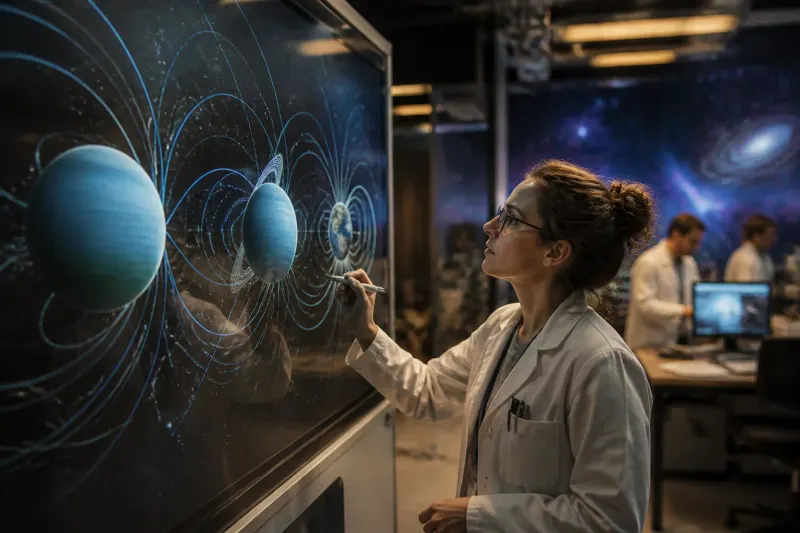
Uranus and Neptune, the ice giants of our solar system, possess magnetic fields that are markedly different from Earth's well-structured geomagnetic field. While Earth generates its magnetic field through a molten core and internal convection processes, Uranus and Neptune's magnetic fields likely arise from the unique electrical conductivity of the fluids inside these planets. This includes substances like water, ammonia, and methane that exist in solid states under high pressure but convert to ionic and superionic phases at great depths.
Dynamo Models and Their Implications
Recent research published in Nature Communications Physics presents dynamo models illustrating how these ice giants' magnetic fields function. The lead author, Chi Yan, a research associate at the University of Texas Jackson School of Geosciences, explains that these non-dipolar and non-axisymmetric magnetic fields are driven by fluid motions in electrically conducting environments within these planets.
Magnetic Field Structure
The magnetic fields of Uranus and Neptune exhibit unusual geometrical shapes that distinguish them from Earth. While Earth's magnetic field is characterized by its north and south poles, which are relatively stable and change position only slightly over time, both Uranus and Neptune display multi-peaked, tilted fields in disarray. For instance, Uranus’ magnetic field is tilted almost 60 degrees from its axis of rotation, and it doesn’t originate from the planet's center. Neptune's magnetic field shares this tilt, offset by approximately 47 degrees from its center.
Temporal Variability
Another notable difference is the variability observed in the magnetic fields of the ice giants. Unlike Earth's magnetic field, which drifts in a predictable manner, the fields of Uranus and Neptune have been described as chaotic, changing in strength and orientation over shorter timescales, potentially within decades. The fields’ configurations are likely different now than during the Voyager 2 flybys, which provided the only close-up observations of these planets.
Electric Conductivity and Its Role
Yan and his colleagues propose that the increase in electrical conductivity with depth inside the planets plays a critical role in generating their unique magnetic fields. As pressures and temperatures rise deep within Uranus and Neptune, materials like water may break apart into ions, enhancing conductivity. This, coupled with the convective motions inside the planets, could explain the non-standard configurations of their magnetic fields.
Voyager 2’s Observations and Their Significance
Voyager 2 remains the only spacecraft to have visited Uranus and Neptune, offering valuable insights into their magnetic fields. Its observations revealed the ice giants' fields not only differ from Earth’s but also from one another. The findings suggested that both planets exhibited strong M-1 peaks, indicating asymmetric magnetic features. This stark difference from other gas giants like Jupiter and Saturn, whose magnetic fields are primarily dominated by symmetric M-0 components, raises significant questions about planetary formation and behavior in extreme environments.
Future Research Directions
Understanding the magnetic fields of Uranus and Neptune is crucial for gaining insights into dynamo processes across different planetary bodies, as highlighted by the authors. The data obtained from Voyager 2, combined with future observations from the James Webb Space Telescope (JWST), may shed light on how these magnetic fields have evolved since the Voyager missions. The JWST has already captured auroral activity on these planets, which responds to their magnetic fields, offering potential clues to their current configurations.
Comparison with Earth’s Magnetic Field
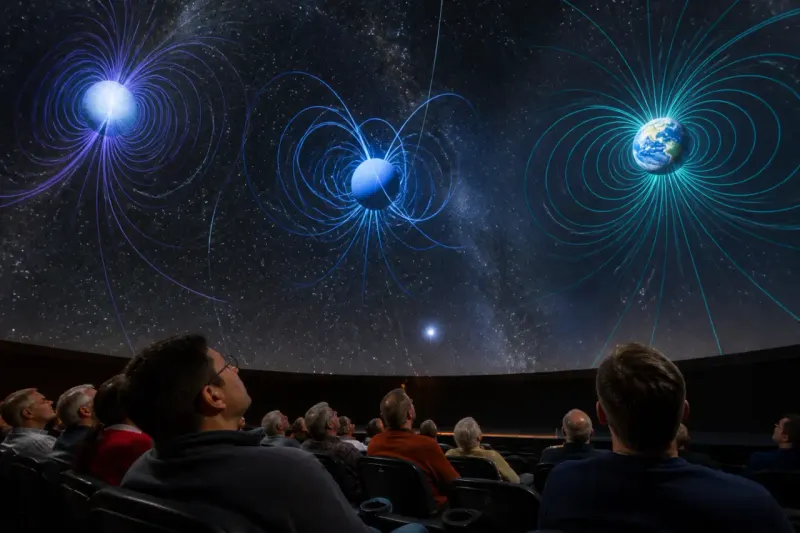
While Earth’s magnetic north pole drifts at a rate of around 5 to 60 km each year, or approximately one degree every few decades, models suggest that the ice giants can undergo significant shifts in their magnetic orientation, swinging by tens of degrees within shorter timeframes. Yan indicates, “Our models show the ice giants can behave very differently,” underscoring the dramatic differences in how planetary magnetic fields can operate.
Concepts for Future Missions
While the research involves advancements in understanding these phenomena, further exploration of Uranus and Neptune is necessary to confirm these findings. NASA has proposed missions such as the Uranus Orbiter & Probe and the Neptune Odyssey, which would include visits to the ice giants and their atmospheres, but these remain conceptual at this stage.
Potential Implications for Habitability
Discussion around the ice giants often touches on habitability, particularly regarding the moons of Uranus. Researchers speculate that major moons may harbor subsurface oceans beneath icy covers. Should these moons indeed possess liquid water, Uranus' magnetic field and its associated radiation belts could significantly influence these potential habitats, impacting chemical interactions and the possibility of life.
Key Takeaways
- Uranus and Neptune exhibit non-dipolar and non-axisymmetric magnetic fields, unlike Earth's well-defined field.
- The magnetic fields of these ice giants change more rapidly than Earth's, potentially shifting dramatically within decades.
- Electrical conductivity increases with depth in the interiors of Uranus and Neptune, influencing their magnetic field generation.
- Future missions like NASA's Uranus Orbiter & Probe could provide essential data to understand these anomalies.
- Potential subsurface oceans on Uranus' moons may be impacted by the unique characteristics of the planet's magnetic field.
Conclusion
The strange magnetic fields of Uranus and Neptune offer vital clues to understanding the diversity of dynamo processes discovered across planetary systems. As scientists continue to analyze past data and gather new observations, the peculiarities of these ice giants may lead to groundbreaking insights into planetary science and the conditions necessary for habitability in distant worlds.
Frequently Asked Questions