
New Insights on Cat's Head Nebula from Hubble and JWST
The Cat's Head Nebula, a captivating region of star formation, has been recently studied through stunning imagery from both Hubble and JWST. Discover the insights gained about its structure and star formation processes.
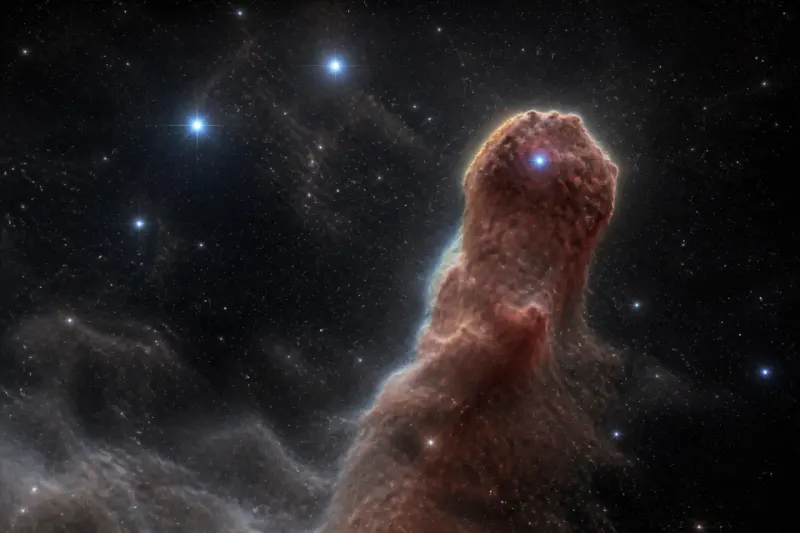
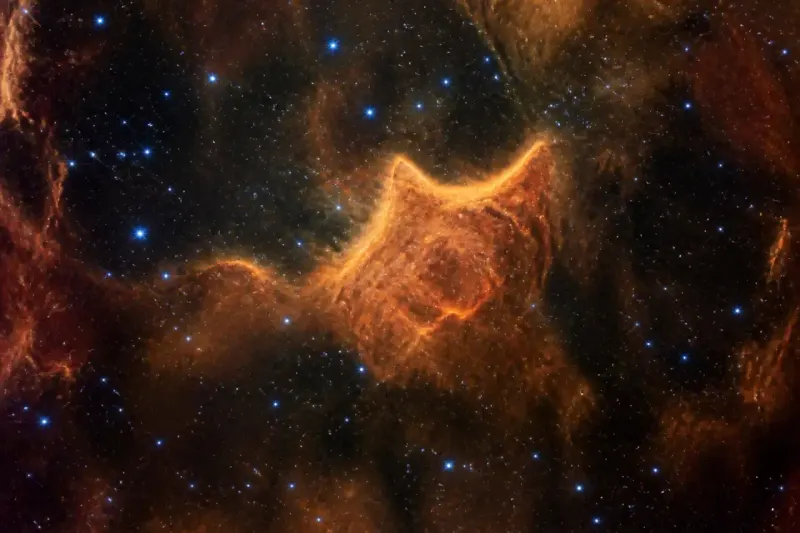
The Cat's Head Nebula captivates the imagination with its peculiar shape, resembling a cat with its head turned back. A recent collaboration between the Hubble Space Telescope and the James Webb Space Telescope (JWST) has provided astronomers with stunning images to enhance understanding of star formation within this mesmerizing nebula.
What is the Cat's Head Nebula?
Located about 7,500 light years from Earth, the Cat's Head Nebula is a small component of the larger Carina Nebula, known for being a prolific star-forming region. Its distinctive appearance has made it a subject of interest among astronomers, with its features shaped by the radiation and stellar winds of nearby massive stars.
The Role of Hubble and JWST
As part of ongoing studies to comprehend the complexities of star formation, both telescopes have targeted the Cat's Head Nebula to explore it through different wavelengths of light. Hubble captures images in visible light, illustrating details about the dust and gas composition. In contrast, JWST employs infrared imaging to reveal aspects hidden from Hubble's view, showcasing the nebula in a novel light.
Astounding Imagery Comparison
The different wavelengths captured provide two unique perspectives of the Cat's Head Nebula:
- Hubble’s Visible Light Images: Showcase the vivid structures of gas and dust within the nebula.
- JWST’s Infrared Images: Highlight the stars and reveal previously obscured details due to dust and gas.
The Features of Cat's Head Nebula
This nebula is significantly influenced by massive stars, particularly from Eta Carinae, a notable stellar system within the Carina Nebula that boasts a luminosity more than 5 million times greater than the Sun. The forces generated by these massive stars sculpt the nebula's form. The Cat's Head is characterized by thick, dark dust, which has, so far, managed to resist the tremendous radiation and winds from these luminous giants.
Structure and Composition
The Cat's Head structure features a gas pillar, which stands under threat from stellar winds and radiation. Hubble’s images reveal yellow outlines at its edges, indicating areas where photoevaporation is occurring. This process is driven by the intense ultraviolet (UV) radiation from massive stars that ionize the gas and lead to evaporation over time.
Color Significance in Astronomy
The colors seen in astronomy images like those of the Cat's Head Nebula do not merely serve aesthetic purposes; they also convey important chemical information. Galaxies can be differentiated by their constituent elements such as hydrogen, sulfur, and oxygen, and the images allow astronomers to infer the ionization levels and energy present, aiding research into stellar feedback affecting star formation.
JWST's Spectacular Infrared Imagery
The JWST’s capabilities provide a dramatically different view. Its instruments showcase the Cat's Head Nebula in near-infrared light, revealing stars that are often obscured in visible light images due to dust. This perspective allows for a clearer view of the nebula’s intrinsic features and also highlights the turbulence within the gas, driven by nearby massive stars.
Ghostly Appearances in Infrared
In the JWST images, parts of the Cat's Head Nebula appear almost ethereal; some regions look partially translucent, allowing background stars to shine through. This effect enhances the nebula's surreal appearance, emphasizing the intricate interplay between stars and their surrounding material.
Mid-Infrared Views
Transitioning to the mid-infrared spectrum, the nebula reveals more muted colors, with a ghostly white appearance that contrasts sharply against pastel background gas clouds. This view highlights the presence of carbon molecules and warmer dust emissions, revealing details such as an infant star hidden within dense dust near the nebula's 'head'. The mid-infrared images bring attention to regions where protostars are likely forming, shedding light on how new star systems develop.
The Significance of Stellar Feedback
Understanding the dynamics of star formation in regions such as the Cat's Head Nebula is crucial for astronomers. Stellar feedback caused by massive stars can significantly influence the star-forming environment, occasionally facilitating or hindering the birth of new stars. This intricate balance between encouragement and stifling of star-forming activity remains a key area of study.
Future Research Directions
The insights provided by the Hubble and JWST are critical to enhancing our comprehensive understanding of stellar formation processes. As research continues, astronomers will aim to synthesize these diverse observations to create a more unified theory about how stars are born, thrive, and influence their environments.
Key Takeaways
- The Cat's Head Nebula is positioned about 7,500 light years from Earth.
- It is situated within the larger Carina Nebula, hosting rich star formation.
- Both the Hubble Space Telescope and the JWST have captured revealing images of this nebula.
- Stellar feedback from massive stars shapes the gaseous and dusty structure of the nebula.
- Differences in imaging technology allow astronomers to view the nebula from multiple perspectives.
By understanding the processes at play in the Cat's Head Nebula, astronomers can elucidate not only the lifecycle of stars but also the broader mechanisms governing cosmic evolution. The images captured by Hubble and JWST offer both breathtaking beauty and invaluable scientific insight, making them an essential component of contemporary astronomy.
Frequently Asked Questions