
New Zealand Election Reflects Gloomy National Sentiment
The recent New Zealand elections illustrate profound gloom and disillusionment among voters, highlighting economic struggles and declining faith in politics.
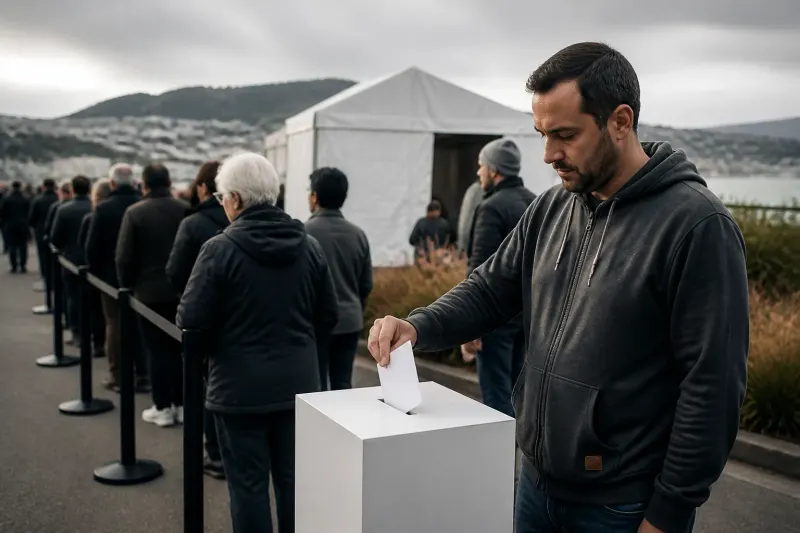
Election Outcomes and Voter Sentiment
New Zealand's recent elections have introduced a significant shift in its political landscape, as the country experiences an unusually gloomy sentiment brought on by economic hardship and disillusionment amongst voters. With fog settling over the capital, Wellington, on November 7, the mood during the election was described as "flat" by many citizens. For instance, Imogen Vlutger, a 21-year-old voter, expressed the sense of apathy that envelops this electoral period, stating, "It's pretty flat. There's this kind of apathy and a bit of dread." This sentiment was echoed by others, highlighting that many Kiwis felt exhausted and disenfranchised by the political process, with even one man admitting he did not vote due to feelings of disillusionment.
Current Economic State
The current state of the economy has left many New Zealanders feeling skeptical about their future. A survey indicates that more than half of the population no longer perceives New Zealand as a land of opportunity, which has driven a record number of residents to leave the country in search of better prospects. Statistics reveal that approximately 180 people are emigrating daily due to increasing dissatisfaction with local job opportunities and rising living costs. Unemployment is reportedly at an 11-year high, with Kiwis under 24 facing job scarcity reminiscent of the dire conditions of the last three decades. For example, Michael Dawson, a 20-year-old who sought employment, noted that he has yet to receive any interviews despite applying extensively, and lamented, "It has sucked. A lot. I'm somewhat cynical with the way I think [about the future] now."
Shifting Political Landscape
The election results reflect profound discontent within the electorate, as a record number of voters opted for smaller parties rather than the traditional major factions. Voters have shown increasing support for the left-leaning Greens, the right-wing libertarian Act Party, and the centrist Opportunity Party, which has seen significant success by winning seven parliamentary seats for the first time. Party leader Quilae Wong expressed elation over this achievement, stating that voters chose to change New Zealand politics for good. Although it will take time to ascertain who will form the governing coalition, the uncertain political environment adds to the challenges ahead.
Key Issues Contributing to Frustration
Many Kiwis attribute their dissatisfaction to a combination of economic and social issues that have accumulated over time. The cost of living remains a critical issue, with financial burdens exacerbated by global supply shocks that have drastically driven up household electricity bills. Moreover, the soaring grocery prices imposed by a supermarket duopoly have resulted in one in four adults skipping meals, pushing many families to their limits.
Healthcare is another area under strain, as long waiting lists for services, chronic understaffing, and crumbling infrastructure plague the system. A poignant example includes a recent news story highlighting the tragic death of a man waiting in an emergency department after a nine-hour wait. Political scientist Luke Oldfield emphasizes a divided populace with a growing sense of anxiety about material hardship and increasing polarization surrounding issues like Māori rights and healthcare.
Youth Challenges
The youth of New Zealand face significant hurdles in a stagnating economy, driving some to question the viability of their futures in the country. Many young individuals are feeling disenchanted with the political system, with feedback from various employment aid organizations indicating that mentally and emotionally drained young people are echoing sentiments of hopelessness. Zainab Ali, the chief executive of Youth Inspire, stated that demand for their services has never been higher, as youth unemployment continues its upward trajectory with around one in three unable to secure sufficient work or remain entirely jobless.

Community Responses
Despite the prevailing gloom, some members of New Zealand society are holding onto hope. Farmers, for instance, are experiencing a turnaround in their fortunes, as noted by farmer Stu Morton, who reported his best year in three decades, suggesting that the agriculture sector could lead the broader economy back to stability after previous challenges posed by emissions reduction policies. This illustrates that while many Kiwis are feeling disillusioned and anxious, there remain segments of the population that report a degree of optimism about their futures.
Public Trust and Future Outlook
The erosion of trust in political institutions has become a major concern. Surveys reveal that only two out of five New Zealanders trust the government to act properly, while less than half express confidence in the judicial system. Helen Clark, a former prime minister, stressed that the rising uncertainty is prompting a crisis of confidence regarding New Zealand's national identity and direction. The transformation promised by former Labour Prime Minister Jacinda Ardern has not materialized, adding to a broader sense of frustration amongst citizens.
Key Takeaways
- More than 180 New Zealanders are leaving the country daily due to dissatisfaction with economic conditions.
- The recent election saw a record number of voters support smaller parties, indicating growing discontent with major political factions.
- Usual perceptions of New Zealand as a land of opportunity have deteriorated, with over half of Kiwis no longer believing they have such prospects.
- Youth unemployment is at a dangerous high, with many individuals feeling hopeless despite their qualifications.
- Trust in government and courts is at an all-time low, with only two out of five Kiwis expressing confidence in leadership.
Conclusion
As New Zealand stands at a crossroads following this election, the outcome reflects deeper issues within its society. Political leaders will face immense challenges in restoring faith in the system, addressing pressing economic concerns, and navigating a divided populace. The coming months will be crucial as parties seek to establish coalitions and outline their plans while contending with the real-life implications of voters' discontent.
Frequently Asked Questions