
Inside the Engineering Marvel of Jet Engine Turbine Blades
This article examines the intricate manufacturing process of jet engine turbine blades and the fierce competition among leading aerospace companies.
Revolutionary Manufacturing Techniques
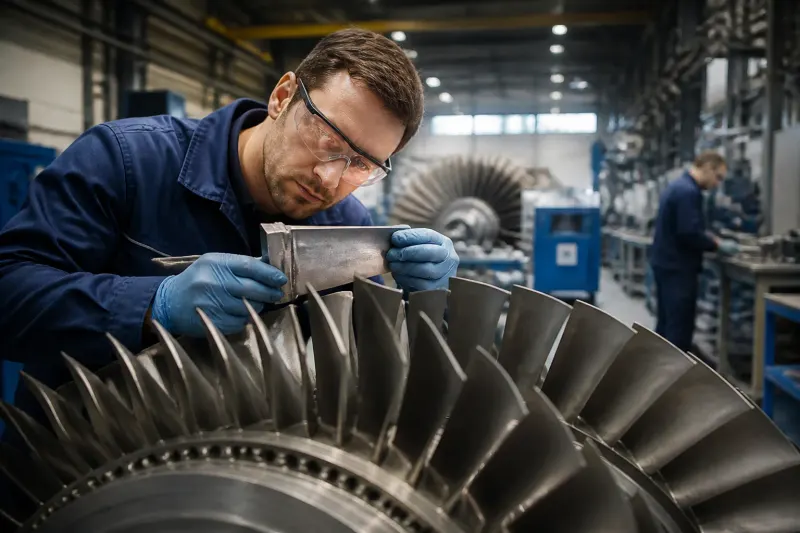
Within the confines of an aircraft, an extraordinary engineering feat occurs inside the jet engines, specifically through the turbine blades. These components are designed to withstand immense mechanical stresses and exceptionally high temperatures, often exceeding 1,500°C. Unlike traditional manufacturing methods where materials are cut or sculpted, turbine blades are uniquely grown. This innovative approach was perfected in the 1960s, when engineers discovered how to take a molten alloy, cast it into the desired shape, and then cool it gradually at a controlled pace, leading to the formation of a single crystal or grain of metal alloy.
Ben Fifoot, a manufacturing engineer at Rolls-Royce, describes this process as one of the most intricate in manufacturing. He articulates, "It's about as complicated as manufacturing gets," reflecting the pride and motivation behind producing these components. Only a handful of companies globally possess the capability to produce single crystal turbine blades, with the manufacturing process being honed in just five countries around the world, including the United States and United Kingdom.
Industry Competition for Advanced Technology
Leading manufacturers like Rolls-Royce, General Electric (GE), and Safran have refined this complex process, engaging in fierce competition for access to this critical technology. A notable strategic move occurred in September 2026 when GE Aerospace announced an acquisition of its turbine blade supplier for $11.75 billion. This acquisition is perceived as a significant step towards securing reliable sources for these essential components amidst a turbulent supply chain in aircraft manufacturing.
Furthermore, in March 2026, Rolls-Royce dedicated over £19 million to enhance its blade casting facility in Rotherham, underlining the urgency and competitive nature of the turbine blade market.
The Complexity of Single Crystal Casting
Understanding the single crystal casting process reveals why it remains a specialized skill set. According to Fifoot, growing a single crystal turbine blade is tantamount to "fighting the laws of the universe". Naturally, molten metal cools into solid forms with numerous crystals amalgamated together. However, for optimal performance, a single crystalline structure is paramount. The challenge lies in controlling the cooling process while leveraging a technique known as a pigtail.
The pigtail, a small spiral at the blade's end, plays a crucial role during the cooling phase. It initially restricts the flow of solidifying crystals, ensuring only one crystal can dominate and form an expertly shaped blade. This technique resembles an F1 racing scenario where a single racer must navigate a tight corner to maintain their lead. Interestingly, adjustments in the pigtail’s turns or angles can further enhance crystal formation. Once the blade is finalized, this pigtail is subsequently removed.
Performance and Design Innovations
Blades manufactured by Rolls-Royce have applications in various aircraft engines, including the Trent XWB-84, which powers the Airbus A350-900, and the Trent 1000 XE used in the Boeing 787. The integrity of the single crystal structure is vital for performance. There are instances when cooling does not proceed as expected and multiple crystals form, necessitating reprocessing of the alloy to reclaim the material.
Further enhancing blade performance, specialized ceramic coatings protect the blades from extreme internal engine temperatures. Additionally, blades are engineered with fine channels to facilitate the circulation of cooler air, helping manage heat levels during engine operation. Paul Withey from the University of Birmingham elaborates that the design goal is currently to intricately shape these cooling passages, as increased turbulence in these air flows helps in dissipating heat from the hotter surrounding air.
Reducing the mass of turbine blades is another priority among manufacturers. A lighter blade translates to increased engine efficiency, allowing operation at higher temperatures and reduced fuel consumption. Fifoot stresses that any weight reduction can enhance overall engine performance.
China's Aspirations in the Jet Engine Market
Meanwhile, China is striving to become the sixth nation capable of fully mastering the single crystal blade casting technology. In a report from May 2026, an engineer at the Aerospace Engine Corporation of China (AECC) claimed that the country has developed a single crystal alloy that could potentially rival the second-generation superalloys commonly employed in European and American manufacturing, stating it costs less to produce.
Despite these advancements, analysts like Bill Sweetman point out that the West maintains a considerable edge, largely due to the concentration of commercial airliner production and the associated supply chains and technological innovations. Furthermore, western manufacturers benefit from extensive safety records which enhance their credibility in the market. Sweetman underscores the uphill battle China faces as it endeavors to compete across numerous facets of aircraft manufacturing, beyond just turbine blades.
Future of Aircraft Manufacturing Demand
The current demand for aircraft is exceptionally robust, placing additional strain on supply chains used in the aviation sector. Some experts, including Paul Withey, predict that demand may escalate even further within the next few years. One of the two major aircraft manufacturers, either Airbus or Boeing, is expected to introduce a new short-haul aircraft which would necessitate the other company to follow suit to stay competitive.
This growing demand will inevitably lead to intense competition over who will supply the engines, and hence the crucial turbine blades. Withey aptly captures the forthcoming rivalry, describing it as a potential “bun fight” among suppliers, highlighting the urgency and high stakes in this vital sector of the aviation industry.
Key Takeaways
- Jet engine turbine blades are created through complex single crystal casting, with temperatures exceeding 1,500°C.
- Key players like Rolls-Royce and GE Aerospace are involved in fierce competition for turbine blade manufacturing expertise.
- China is making strides in single crystal blade technology, though it faces significant challenges compared to Western manufacturers.
- Industry demand for aircraft is expanding, leading to tighter competition over engine and turbine blade supply.
Conclusion
The realm of jet engine turbine blade manufacturing is a striking example of advanced engineering and the competitive dynamics within the aerospace sector. As demand rises and new players emerge, the emphasis on innovation and production capabilities will only intensify, propelling advancements that contribute to the future of aviation technology.
Frequently Asked Questions