
NexCOBOT Explores Physical AI Market Dynamics and Challenges
NexCOBOT's insights reveal dynamics in the physical AI market, focusing on acquisitions by major tech firms, funding challenges, and the future of robotics.
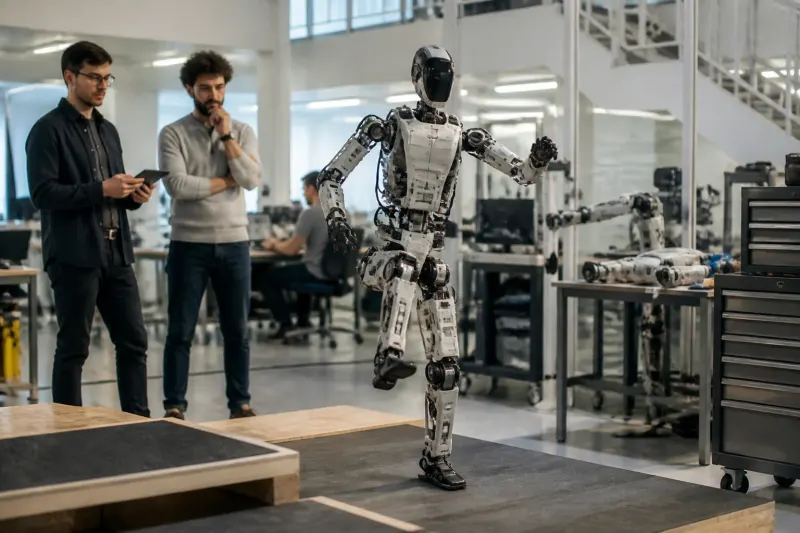
NexCOBOT is at the forefront of discussions surrounding the evolution and acceleration of the physical AI market, an area marked by significant investment and acquisition activity. The company, which showcased its innovations at the Robotics Summit & Expo, is seeing rising demand for its controllers that cater not only to traditional robots but also to newcomers like legged robots and mobile manipulators. In a conversation with Jenny Shern, the general manager of NexCOBOT, insights were shared about how these dynamics are shaping industry trends.
Key Acquisition Highlights
In the past year, major technology firms have aggressively expanded their reach into the robotics sector through substantial acquisitions. For example, Mobileye acquired Mentee Robotics for $900 million in January, marking a significant investment in the physical AI landscape. Similarly, Amazon purchased Fauna Robotics in March, and Meta acquired Assured Robot Intelligence in May. These acquisitions highlight a clear trend where large tech conglomerates leverage their resources to integrate existing innovations from smaller robotics companies that excel in specialized areas like autonomous control and perception.
According to Shern, this acquisition strategy enables tech giants to assimilate expertise and technological advancements swiftly, positioning them effectively as the robotics field rapidly evolves. "As AI models improve, acquiring these companies allows for streamlined development and establishes competitive advantages in the next era of intelligent systems," she responded.
NexCOBOT's Financial Stability
Despite not disclosing detailed financial information, Shern described NexCOBOT as being in a strong financial position. The company continues to prioritize scaling its open and functional safety robotic controllers and fulfilling a robust backlog of global orders as it gears up for mass production. The operational focus remains on leveraging their motion control technology to meet the needs of an increasingly diverse robotics landscape.
Funding Challenges and Industry Collaboration
The funding climate for robotics has changed, as Shern pointed out, with venture capital investment in early-stage companies reportedly declining. While U.S. funding for physical AI has increased, this new environment compels robotics developers to demonstrate strong differentiation in their offerings. Startups are expected to validate their business models more rapidly, possibly hindering the influx of new entrants. However, Shern also sees potential benefits in this shift, promoting increased collaboration between startups, industrial firms, and larger technology companies.
Selective Funding Landscape
In this more selective funding landscape, capital remains accessible to those demonstrating market viability and technical differentiation. As a result, robotics innovation is likely to focus on addressing tangible operational challenges, possibly leading to greater efficiencies and advancements in the manufacturing process.
Understanding AI-native Robots
Shern elaborated on the concept of “AI-native robots,” which refer to machines designed from the ground up to integrate AI at their core. Unlike traditional robots that strictly follow predetermined instructions, AI-native robots can adapt and learn from new data inputs, enhancing their functionality in dynamic environments. Noteworthy advancements have been more pronounced in areas such as perception, motion planning, and human-robot interaction.
Reliability and Safety Concerns
Despite rapid advancements, challenges surrounding reliability and safety ensure that the adoption of these AI-native robots will be gradual, particularly in industrial applications. This caution is rooted in the need for technologies to prove themselves in real-world scenarios before they are fully embraced within established industrial processes.
Mainstreaming Physical AI
An essential question arises regarding how large tech firms can optimize the importation of AI into robotics effectively. Shern indicated that decoupling software innovation from hardware design could bridge the disparity in pace between the two fields. As software and AI evolve at a faster rate, modular platforms with standardized interfaces can facilitate the deployment of new AI capabilities to existing robot systems without the need for complete hardware overhauls.
This modular approach allows developers the agility to adapt rapidly to new software advancements while ensuring that the hardware remains robust and reliable for industrial applications. The ongoing interplay between hardware durability and software flexibility will significantly influence the evolution of robotics in various sectors.
Open Ecosystems and Market Opportunities
The increasing adoption of open robot control platforms exemplifies how an open ecosystem benefits both suppliers and users. For clients, utilizing certified functional safety controllers based on open systems can drastically reduce development cycles. For example, one of NexCOBOT's clients managed to cut their anticipated development timeline from three to five years down to just two years by adopting this approach.
Collaborative Development
Additionally, open ecosystems enhance market opportunities for suppliers, promoting interoperability across various platforms and industries. These collaborative frameworks foster innovation, allowing more rapid development cycles while simultaneously lowering adoption barriers for new technologies.
Physical AI's Future Segments
Shern predicts that Big Tech firms will diversify activities across both established industries like manufacturing and emerging service sectors facilitated by physical AI advancements. Industries such as logistics and warehousing provide concrete business use cases for automation, presenting lucrative scaling opportunities.
Dynamic Environments and Service Applications
At the same time, the evolving efficacy of AI opens new possibilities for robots to operate in less structured environments, notably in service applications and healthcare support. There is a strong demand for robotic systems in settings beyond traditional industrial applications, hinting at the long-term transformative potential of physical AI across various sectors.
Robots Attractive to Big Tech
In examining specific types of robots likely to attract Big Tech, Shern noted that systems capable of generating substantial amounts of operational data while also lending themselves to AI improvements are most appealing. Humanoid robots, mobile robots, and those designed for dynamic environments align with the strategic interests of large technology companies.
Market Appeal of Specialized Robots
Conversely, highly specialized robots tailored for narrow industrial tasks may face challenges in garnering interest unless they offer unique proprietary technology or tackle significant market opportunities. Ultimately, technologies seen as possessing expansive scalability across multiple industries are more attractive to firms seeking long-term competitive advantages.
Key Takeaways
- Major acquisitions like Mobileye's purchase of Mentee Robotics showcase the growing interest from Big Tech in physical AI technologies.
- NexCOBOT focuses on its core open control systems while remaining in a stable financial position.
- The push for funding in robotics is evolving, with a need for startups to prove business models quickly.
- AI-native robots designed for adaptability are dominating advancements in perception and interaction.
- Open systems are improving development cycles and collaboration across the robotics sector.
NexCOBOT’s strategic positioning within the physical AI market exemplifies the significant shifts occurring amidst escalating competition and growing interest from major technology players. By leveraging their experience and technology, the company is poised to navigate the evolving landscape while maximizing opportunities in both traditional and emerging sectors.
Frequently Asked Questions